Millennium Falcon: Smugglers Run Gets a Mandalorian & Grogu Upgrade – But Is It Finally the Ride Fans Wanted?
Stepping Into the Cockpit, Finally Feeling It
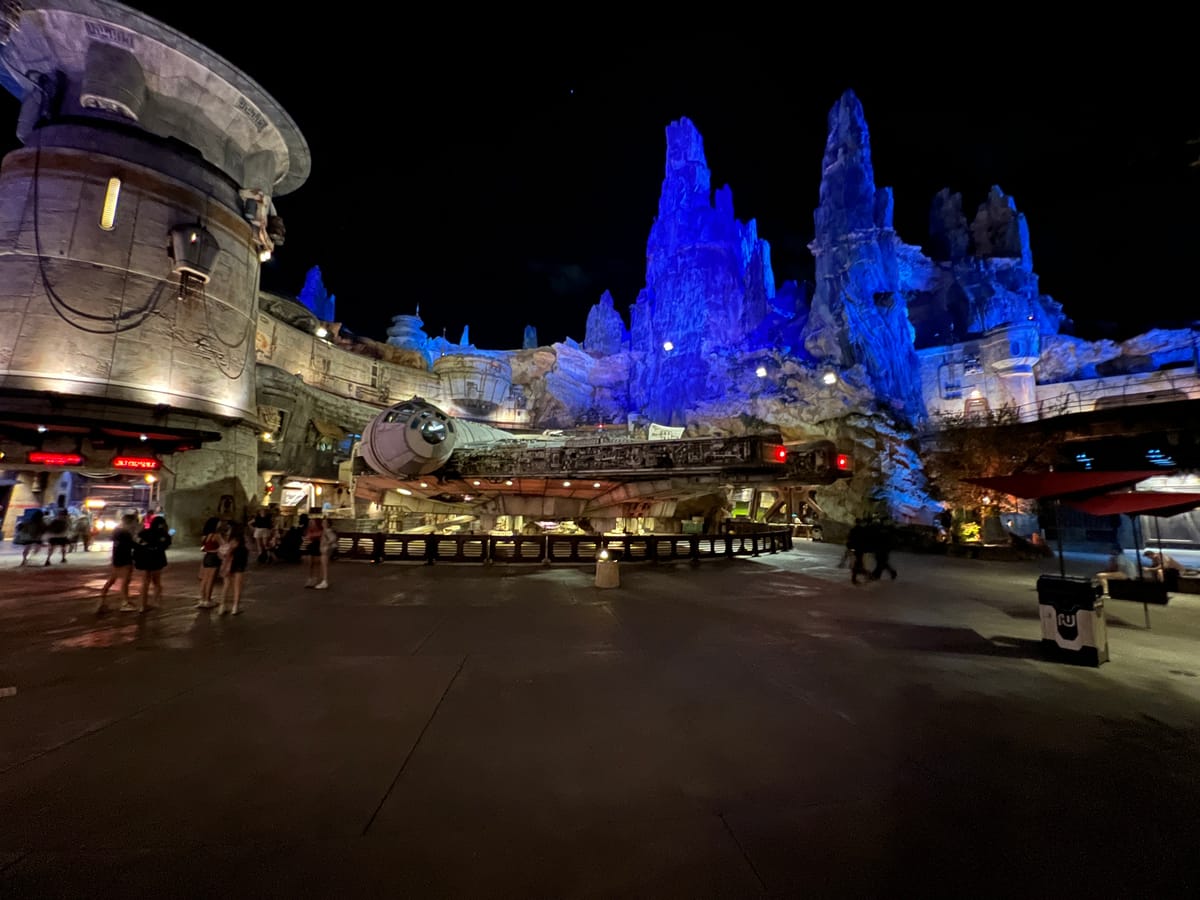
There is a moment, just before the blast doors slide open and the Millennium Falcon fills your entire field of vision, when Galaxy's Edge does something almost unfair. The smell of machine oil and overheated metal drifts through the air. The hum of something enormous and barely contained vibrates just beneath your feet. A droid chirps somewhere in the distance. And then there she is — all battered hull panels, asymmetrical geometry, and impossible legend — and your brain simply forgets for a moment that you are standing in a theme park in Anaheim or Orlando. That moment has always been extraordinary. What came next, for too many guests over too many years, was where things got complicated.
Millennium Falcon: Smugglers Run opened in 2019 alongside the rest of Star Wars: Galaxy's Edge, and it carried with it an almost impossible weight of expectation. You were going to fly the Falcon. The Falcon. The ship that made the Kessel Run. The ship Han Solo called a piece of junk with the unmistakable pride of someone who knew better. And while the attraction delivered one of the most spectacular pre-show environments Disney has ever constructed, the actual ride experience left a significant portion of guests feeling oddly flat. The controls felt disconnected. The consequences of your choices felt minimal. The story, such as it was, never quite ignited. Now, years later, with a Mandalorian and Grogu-themed upgrade woven into the experience, Disney is taking another run at the premise. The question worth asking honestly and without the reflexive enthusiasm of a press release is this: does it finally work?
What the Upgrade Actually Changes
Let's be precise about what has been added, because the details matter. The update integrates characters and narrative elements from The Mandalorian & Grogu into the Smugglers Run framework, most significantly through new pre-show content, updated mission briefing sequences, and the inclusion of Mando and the Child within the story context that sends your crew scrambling into the cockpit. Hondo Ohnaka, the lovably crooked Weequay pirate who has served as the ride's host since opening day, remains central to the experience — his voice, his scheming energy, his total willingness to put you in danger for profit. But the new content layers in an additional thread, a reason for urgency that feels slightly more textured than a simple coaxite spice run.
The cockpit itself, that cramped and gloriously detailed six-person chamber with its flashing switches and worn leather seats and circular viewport, has not been structurally altered. The three crew roles — pilots, gunners, and engineers — still divide your group into functional pairs, each with different buttons to press and responsibilities to manage. What has shifted is the surrounding narrative momentum. The mission briefing now carries more stakes. The characters feel less incidental. And the overall tone, while still playful and Hondo-inflected, reaches a little more deliberately for genuine tension.

Why the Original Version Divided People So Sharply
To understand why this upgrade matters, you have to understand what the frustration with the original was actually about. It was never the physical environment. Walk through the queue and you move through the underbelly of the Falcon herself — ducking past exposed conduit and cargo crates and the dejarik table where Chewie notoriously does not let you win. The attention to detail is staggering, tactile, obsessive in the best possible way. Every scuffed surface tells a story. Guests who slow down and actually look find themselves in one of the richest themed spaces in the world.
The dissatisfaction centered on a specific gap between promise and delivery. When you sit in the pilot seat and wrap your hands around those controls, you are sitting in what might be the most iconic fictional cockpit in cinema history. The expectation that floods through you in that moment is enormous. And the ride's motion simulator technology, while technically competent, produced an experience that felt curiously weightless — not in the thrilling zero-gravity sense, but in the sense that your actions didn't seem to register with the visceral feedback a pilot fantasizes about. Press the wrong button repeatedly and you'll see damage accumulate on the ship's exterior score, but the chaos rarely felt urgent. Gunners frequently reported feeling like they were participating rather than contributing. Engineers described frantically hammering buttons while the cockpit erupted around them, never quite sure if anything they did mattered to what appeared on screen.
None of this made Smugglers Run a bad attraction, exactly. But it made it a slightly melancholy one. The gap between what it was and what it could have been was always visible, like a horizon you could see but couldn't quite reach.
Does the Mandalorian Upgrade Close That Gap
Honestly, and with genuine affection for everything Disney's Imagineers have built here, the answer is: partially. And partially is more than nothing, which is worth saying clearly.
The new pre-show content is where the upgrade earns its keep most convincingly. There is a warmth and specificity to the Mandalorian characters that slots naturally into the Star Wars underworld aesthetic Galaxy's Edge has always inhabited so well. Mando's quiet intensity, the wordless expressiveness of Grogu, the sense of a universe with ongoing stakes — these elements give the mission briefing an emotional texture it previously lacked. You're not just running a job for a mercenary with good comedic timing. There's something that feels slightly more like a story being told.
The cockpit sequence itself benefits from this context, even if the fundamental mechanics remain unchanged. Knowing why you're flying, knowing vaguely who you're flying for, gives the chaos a frame. Pilots who engage with the narrative rather than simply reacting to button prompts report a noticeably more satisfying experience. The gunners' turret sequences feel slightly more purposeful when the targets are connected to something the pre-show established. Engineers still have the hardest job in terms of visible feedback, but the rhythm of the ride now has enough surrounding story that even a rough landing feels like it happened inside a real mission rather than a vacuum.
What the upgrade does not do is overhaul the ride system itself. The motion profile is what it is. The gap between pilot input and visual response, that slight disconnect that has always separated Smugglers Run from the sensation of actually flying, remains present. If that was your primary frustration in 2019, the new content will soften it at the edges without eliminating it entirely.

Practical Information for Planning Your Visit
Millennium Falcon: Smugglers Run is available at both Disneyland Resort in California and Walt Disney World's Hollywood Studios in Florida, where it anchors the Star Wars: Galaxy's Edge land at each park. Lightning Lane access is available through the Lightning Lane Single Pass option and is worth considering if you want to ride more than once, since the experience shifts meaningfully depending on which crew role you're assigned. If you have not flown as a pilot before, make the request. It is a different experience from the gunner or engineer positions, and it is the version of the ride most likely to produce the feeling you were hoping for when you first saw the Falcon in the queue.
Height requirement is 38 inches, making this accessible to most families with young children, which pairs nicely with the Grogu-forward new content — the character has an obvious appeal for younger guests who may not carry the same nostalgic weight of the original trilogy but who know exactly who that big-eyed little green creature is. Arrive early or use Lightning Lane; standby waits can build significantly as the day progresses, particularly at peak seasons.
Plan to spend time in the queue even if you've ridden before. The environment rewards attention, and there are details — painted panels, stowed equipment, ambient sound design — that reveal themselves slowly and generously to guests who are not racing to the loading bay.
A Ride Still Becoming What It Wants to Be
There is something genuinely endearing about Disney continuing to work on this attraction. It would have been easy to declare it finished and move on. Instead, there's evident care in the decision to layer in new narrative — to acknowledge, without quite admitting it, that the story always needed more breathing room. The Mandalorian upgrade is not a reinvention. It is a refinement, and a thoughtful one, applied to an experience that was always more promising than it was fully realized.
What Smugglers Run has always gotten right, and what no upgrade can diminish or replace, is that initial sight of the Falcon herself. No amount of mechanical critique survives that moment intact. You see her, and something in you simply responds. The upgrade makes what follows that moment a little more worthy of it. That's not everything fans wanted. But standing in the shadow of the most famous ship in a galaxy far, far away, it turns out to be quite a lot.
Source: micechat.com